


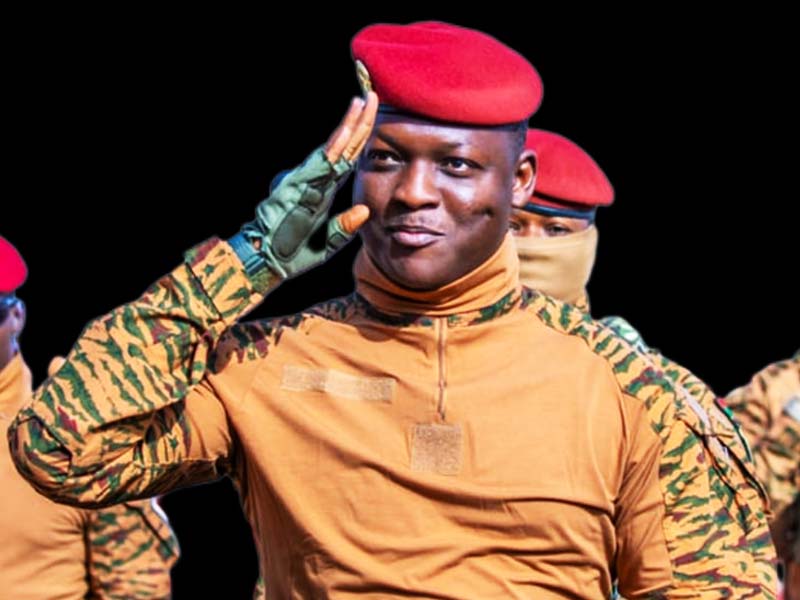
At just 36 years old, Captain Ibrahim Traoré stands as the world's youngest president and arguably one of Africa's most transformative leaders.
Since taking power in September 2022 through a military coup, Traoré has embarked on an ambitious agenda to reshape Burkina Faso's economic landscape, reclaim its natural resources, and improve the lives of its citizens.
Traoré's economic philosophy represents a bold departure from traditional African governance. In a move that shocked the international community, he rejected loans from both the International Monetary Fund and the World Bank, declaring that "Africa doesn't need the World Bank, IMF, Europe, or America." This stance reflects his commitment to economic sovereignty and self-determination.
Under his leadership, Burkina Faso's GDP has grown from approximately $18.8 billion to $22.1 billion, demonstrating that his unconventional approach may be yielding results. His administration has prioritized domestic debt repayment, successfully clearing local debts while maintaining economic growth.
In a striking display of his priorities, Traoré reduced ministerial and parliamentary salaries by 30% while increasing civil servant wages by 50%. This redistribution of resources reflects his commitment to ordinary workers and signals a shift away from the traditional elite-focused governance that has characterized many African nations.
Perhaps Traoré's most significant achievement has been the nationalization of Burkina Faso's mineral wealth. He has nationalized two gold mines and, critically, stopped the export of unrefined gold to Europe. Instead, he inaugurated a national gold refinery expected to process 150 tonnes annually, ensuring that more value from the country's resources stays within its borders.
The momentum continued in June 2025 when five additional gold mining assets were transferred to state ownership. This is particularly significant given that Burkina Faso ranks as Africa's fourth-largest gold producer. By controlling its gold supply chain from extraction to refinement, the country is positioned to capture far more economic value than the traditional model of exporting raw materials.
Traoré's vision extends beyond mining. He has established two tomato processing plants, the first of their kind in Burkina Faso, transforming the country's approach to agriculture and food security. His administration has also built a second cotton processing plant and opened the first National Support Center for Artisanal Cotton Processing, creating jobs and adding value to one of the country's key agricultural products.
These industrial initiatives represent a fundamental shift in economic strategy. Rather than simply exporting raw materials, Burkina Faso is now processing its own resources, creating employment, developing technical skills, and retaining more profits within the country.
Infrastructure development has been another cornerstone of Traoré's presidency. The Ouagadougou-Donsin Airport is under construction and expected to be completed in 2025, with capacity to handle 1 million passengers annually. This project will enhance Burkina Faso's connectivity and support economic growth through improved trade and tourism opportunities.
His government is also constructing new roads and upgrading existing infrastructure, addressing critical bottlenecks that have historically hindered economic development and rural access to services.
Traoré's healthcare initiatives demonstrate his commitment to improving quality of life for all Burkinabè, particularly those in remote areas. The government introduced mobile clinics equipped with 36 vehicles, including 13 refrigerated ones for delivering vaccines and medicines safely to rural communities that lack hospitals or medical facilities.
The program's infrastructure includes 11 cold storage rooms and 1,900 solar-powered refrigerators to keep vaccines safe in areas without electricity. The healthcare system now utilizes 835 digital tablets to improve medical records and enable telemedicine services, bringing modern healthcare technology to a developing nation.
Free medical services have expanded significantly under his leadership. A large-scale program offers free cataract surgery, which has helped 4,000 people regain their sight. The government also provides free or subsidized healthcare for pregnant women and children, with programs aimed at reducing infant mortality and ensuring universal access to vaccinations.
The administration has focused on modernizing healthcare infrastructure, ensuring consistent medicine supplies, and enhancing medical professionals' skills, with special attention to expanding services in underserved rural areas.
Traoré's foreign policy reflects his commitment to African sovereignty. He banned French military operations and French media, expelled French troops from Burkina Faso, and withdrew from ECOWAS (Economic Community of West African States). In their place, he formed the Alliance of Sahel States with Mali and Niger, creating a new regional partnership independent of Western influence.
This bold stance has resonated across Africa. At President Mahama's inauguration in Ghana on January 7, 2025, Traoré received the loudest applause among all 21 African heads of state present, signaling his growing popularity across the continent.
Despite these achievements, Traoré's presidency faces significant challenges. An ongoing Islamist insurgency affects approximately 40% of the country's territory, with thousands of schools and health facilities closed in affected areas. This security crisis threatens to undermine progress in education and healthcare delivery.
Ibrahim Traoré represents a new generation of African leadership that rejects the traditional post-colonial economic model. His emphasis on resource nationalization, economic independence from Western financial institutions, and investment in local capacity building offers an alternative vision for African development.
Whether this model proves sustainable remains to be seen. The security challenges, questions about democratic governance, and the long-term economic viability of his policies will determine whether Traoré's revolution succeeds or falters.
What is clear, however, is that Ibrahim Traoré has captured the imagination of many Africans who see in him a leader willing to challenge the status quo and prioritize African interests over foreign influence. His presidency, whether it succeeds or fails, will likely influence African political discourse for years to come.
As Africa's youngest and arguably most popular president, Traoré stands at a crossroads. His achievements in economic growth, resource control, industrial development, healthcare, and infrastructure are undeniable. The question now is whether he can sustain this momentum while addressing the security and democratic challenges that threaten to derail his revolutionary vision for Burkina Faso and, perhaps, for Africa itself.
